
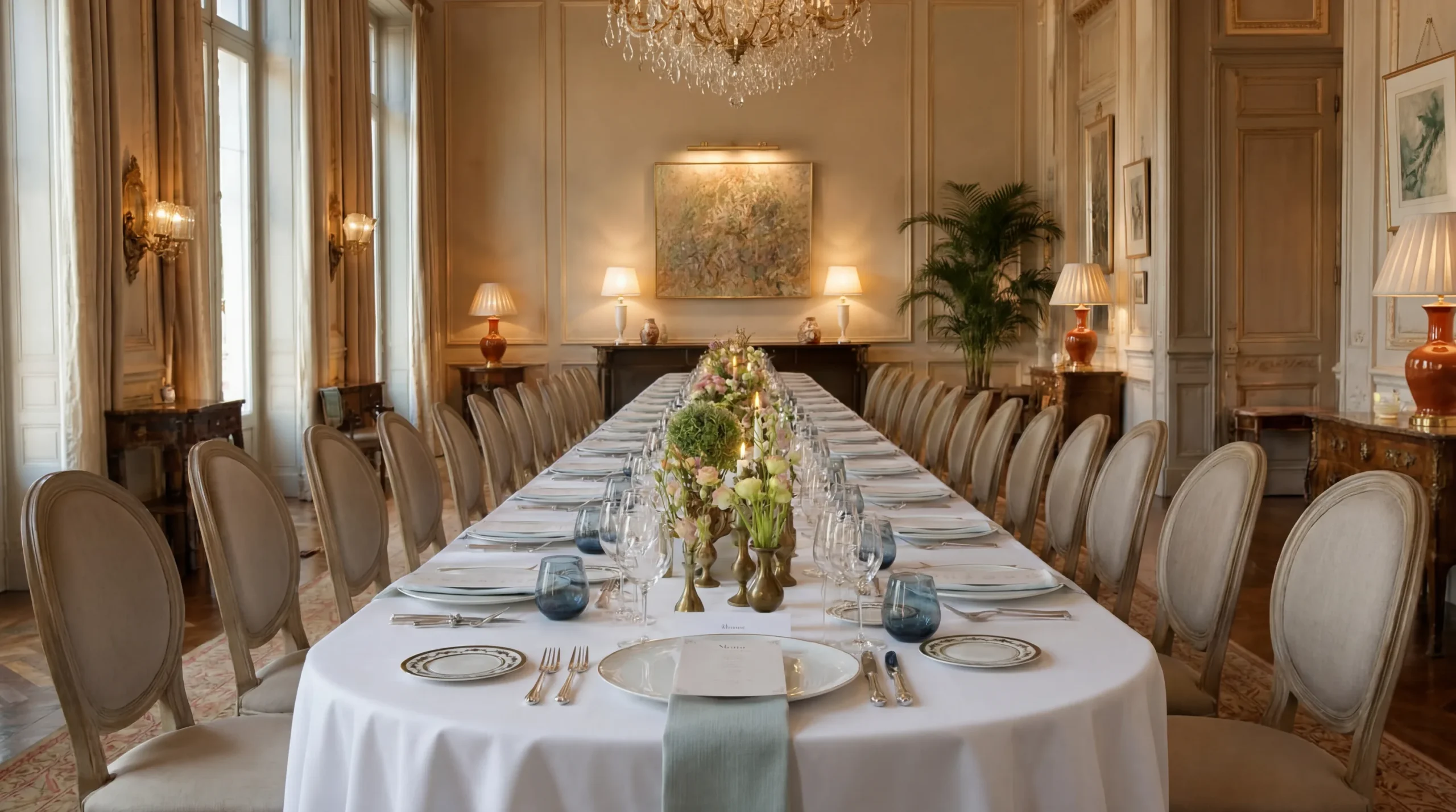
This guide sets out the precise rules of French table setting, from the choice of linen to the placement of glasses, with the historical anecdotes that explain each convention, and shows how to adapt the protocol from an intimate dinner to a prestige meal.
An art inherited from centuries of gastronomy
Part of the cultural heritage of humanity
The gastronomic meal of the French is not just what is on the plate. The 2010 UNESCO listing covers the whole ritual: the choice of dishes, the care taken in setting the table, food and wine pairings, conversation around the table. France was one of the first countries to obtain this recognition for a culinary practice. The heritage lives on in every choice you make before your guests sit down: the tablecloth, the order of cutlery, the position of the glasses. Each element has its logic, often an ancient one.
Service à la française and service à la russe: a historical confusion
For a long time, the great European tables practised service à la française: all the dishes of a course were placed on the table at once and guests helped themselves. A visual feast, but impractical as the dishes cooled. In the early nineteenth century, Prince Alexander Kurakin, Russian ambassador to France, introduced service à la russe: dishes presented one after another and served by staff directly onto each guest's plate. Far better suited to gastronomic tables, it gradually spread across France and Europe. Today, "setting a French table" really means the formal place setting that accompanies service à la russe, as practised by great houses and gastronomic restaurants.
Tablecloth and linen: the foundations
Choosing the tablecloth
A formal French tablecloth is white (or off-white) linen or cotton: these materials hold a crease and form the understated backdrop for everything else. Size matters as much as material: the cloth should drop 25 to 30 cm on each side, no more (it touches the knees) and no less (it looks skimpy). For semi-formal receptions, a coloured cloth or individual placemats are perfectly acceptable, provided the materials are of quality.
The table pad: the secret of great houses
In exceptional houses, a felt pad (also called a silence cloth) is slipped between the table and the cloth. It protects the table from knocks and heat, stops the cloth from slipping and, above all, gives it the perfectly smooth, taut drop typical of professional settings. Invisible to guests but immediately perceptible to the eye.
Fabric napkins
The formal napkin is fabric, matching the cloth or in a harmonious colour. It sits to the left of the plate, folded in a rectangle or roll, or on the charger in a simple fold. Elaborate birds or flowers belong to buffets and holiday hotels: on a gastronomic table, restraint prevails.
Placing the plates
The charger and the order of plates
In a formal setting, a charger (or presentation plate) is placed before guests arrive. It never holds food: it is decorative and structural, receiving the soup plate, then the starter plate, then the main plate as the meal progresses. In a semi-formal setting, it can be replaced directly by the dinner plate.
Distances to respect
The plate sits 2 cm from the edge of the table, neither against the edge (risk of falling) nor pushed too far in. Each guest needs 60 to 70 cm of width along the table, 50 cm being the absolute minimum below which elbows touch. Professionals call this the guest's "living space", and it conditions comfort throughout the meal.
| Element | Distance or position |
|---|---|
| Plate from the table edge | 2 cm |
| Width per guest | 60 to 70 cm (50 cm minimum) |
| Tablecloth drop | 25 to 30 cm on each side |
| Forks | On the left, tines facing the cloth |
| Knives | On the right, blade facing the plate |
| Glasses | On a diagonal: water (left), red wine, white wine (right) |
The order of cutlery
The golden rule: from the outside in, in order of use
Cutlery is laid in reverse order of use, from the outside towards the plate: the first pieces used (often the starter knife and fork) sit furthest out, those for the main course closest to the plate, so guests simply take the outermost piece at each course. Knives go to the right of the plate, blade facing the plate, never pointing at a neighbour. Forks go to the left, tines facing the cloth.
The coat of arms: why forks face down
In France, forks are laid tines down, unlike the English-speaking practice of tines up. The explanation is historical: noble families had their coats of arms engraved on the back of the handles, and placing forks tines down displayed them to guests, a discreet signal of lineage. The tradition outlived the families that created it. Tradition also credits Catherine de' Medici, arriving from Italy in the sixteenth century with refined cutlery, with spreading the fork among the French nobility; historians nuance the story, but the fork was firmly established at the French court in the second half of that century.
Soup spoon, butter knife, dessert cutlery
The soup spoon sits to the right of the knife, on the outside, as it is used first if a soup opens the meal. The butter knife lies horizontally on the bread plate, placed to the left of the plate, slightly above the forks. Dessert cutlery sits horizontally above the plate: the dessert fork pointing right, the dessert spoon pointing left. And the rounded table knife seen on every great table? Tradition says Cardinal Richelieu, irritated by guests picking their teeth with the point of their knives, had the blades rounded, and under Louis XIV the shape became compulsory at court: a rule of civility turned universal convention.
Glasses on the diagonal
Water, red wine, white wine
Glasses are arranged on a diagonal running from upper left to lower right:
- Upper left: the large water glass, the biggest, as water is drunk throughout the meal
- In the centre: the red wine glass, wider to aerate the wine
- Lower right: the white wine glass, smaller and narrower
The logic is functional: the tallest glass at the back for visual stability, and the glasses within reach in order of service, as white often precedes red.
Champagne flute and digestif glasses
If champagne is served as an aperitif or with dessert, the flute continues the diagonal to the right of the white wine glass; at large receptions it may be brought only when needed. Digestif glasses are never part of the initial setting: they arrive at the end of the meal.
Decoration: flowers, candles, centrepieces
Flowers: low, unscented and seasonal
Flowers on a gastronomic table should never rise above guests' eye line, or they block the view and create a barrier between those seated opposite. Second rule: no scented flowers, which compete with the aromas of food and wine. Unscented roses, orchids, anemones and seasonal ranunculus are the professionals' choices.
Candles, table runner, place cards
Candles bring an incomparable warm light; on a formal table, choose white or ivory candles in classic holders, and avoid scented ones for the same reason as flowers. A linen or velvet runner is an elegant alternative to a full cloth for a contemporary setting, or a decorative complement on a cloth. Place cards are a must for formal settings of more than eight: they avoid confusion and allow a considered seating plan.
Adapting the setting to the occasion
Formal: prestige dinner, official reception
The full protocol: charger, complete silverware (up to five pieces per guest depending on the menu), champagne flutes, place cards, white linen cloth over a pad, a runner or low floral centrepieces. It is the natural setting for live culinary experiences such as wine or cheese tastings led by a sommelier or a Meilleur Ouvrier de France.
Semi-formal: family meal, dinner with friends
The protocol is lightened without being betrayed: keep the overall logic (order of cutlery, diagonal of glasses, fabric napkins) but simplify, with no charger necessarily, three pieces of cutlery per guest for a classic menu and a coloured cloth if you like. Proportion and neatness remain essential: a well-proportioned semi-formal table is more elegant than a sloppy formal one.
High-end: the touch of great houses
What distinguishes the table of a great house is often imperceptible: hand-finished linen with an embroidered monogram, millimetre-precise placement, harmony between the pieces of tableware. No piece sits 3 cm from the edge when the rule says 2. It is also the coherence between the setting and the rest of the experience: menu, wines, light, music. A high-end table is not improvised on the day; it is prepared, often with professionals.
Why not entrust the setting and service to professionals?
The role of the maître d'
On a great table, the setting is only the visible part of a much larger job. A professional maître d' does not just lay the cutlery: they think through the whole service, from seating plan to the pace of the courses, dietary needs, welcoming guests and coordinating with the chef. That coordination ensures the meal runs without a false note and every guest feels expected and considered: service as practised in starred restaurants, which Prémices recreates in its clients' private spaces. For a bespoke gastronomic dinner at home, Prémices can provide a selected chef who designs the menu and a maître d' who manages service from start to finish, from setting the table before your guests arrive to tidying the kitchen after the meal.
Hosting a gastronomic dinner at home
Hosting a gastronomic dinner at home combines several skills: quality produce, the chef's art, the logistics of service and the art of the table described here. For those who want the experience without the logistics, Prémices takes care of every step with chefs selected on demanding criteria (punctuality, plating, quality of service), reflected in a 4.9/5 Google rating. See also our guide to entertaining with elegance.
A chef and a maître d' for your next dinner? Request a quote.
Frequently asked questions
How do you set a French table?
Lay a white linen or cotton cloth with a 25 to 30 cm drop on each side. Place the plate 2 cm from the edge, with 60 to 70 cm per guest. Cutlery goes from the outside in, in reverse order of use: forks on the left, tines down; knives on the right, blade facing the plate. Glasses run on a diagonal: water (large, back left), red wine (centre), white wine (front right). The fabric napkin sits to the left of the plate.
How is the fork placed in a French table setting?
To the left of the plate, tines facing down towards the cloth. The tradition dates from the Renaissance, when noble families engraved their coats of arms on the back of the handles and turned the forks over to display them. With several forks, arrange them from the outside in, following the menu.
What is the ideal distance between two places?
At least 50 cm of width per guest, ideally 60 to 70 cm for comfort. The plate itself sits 2 cm from the edge of the table.
What does "dresser la table" mean?
It is the French expression for the whole place setting before a meal: cloth, plates, cutlery, glasses, napkins and decoration. In France, the practice was codified over centuries into a precise protocol, recognised as part of the gastronomic meal of the French on UNESCO's intangible heritage list in 2010.