
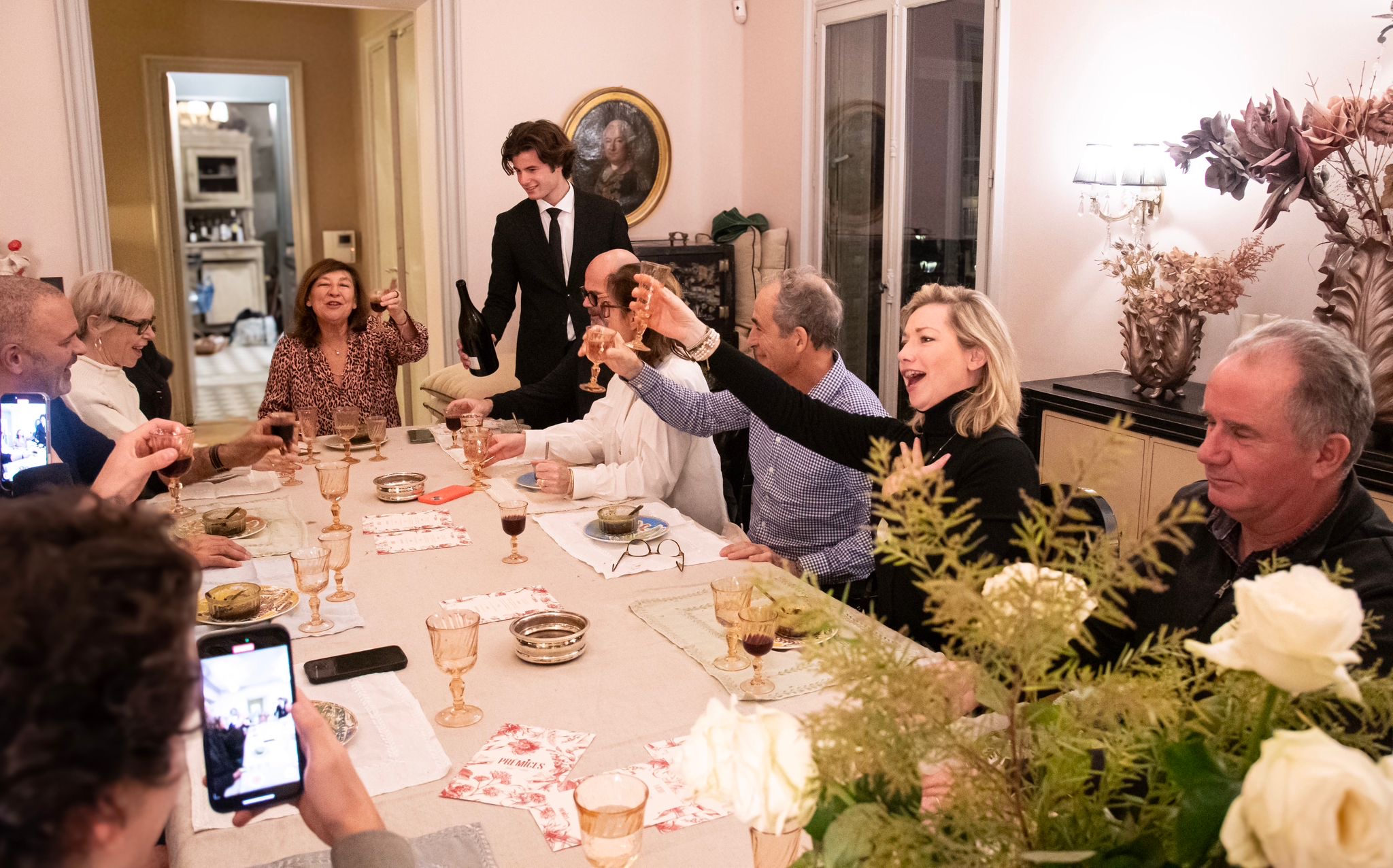
At Prémices, every service is designed with this logic: chefs and sommeliers build the wine selection together for each course. Discover our private sommellerie service for your dinners and events.
What is food and wine pairing?
The definition sommeliers use
A food and wine pairing is the deliberate association of a wine and a dish so that each enhances the other. It is not just about avoiding an unpleasant combination: a successful pairing creates synergy, a mutual lift you feel neither with the wine alone nor with the dish alone. Sommeliers distinguish two main families: complementarity, where intensities answer each other and structures align, and contrast, where opposites balance, like the salt of Roquefort tempered by the sweetness of Sauternes. A third, more cultural principle completes them: the regional pairing, which matches wines and dishes from the same terroir.
Why a well-chosen pairing transforms the experience
When a pairing is mastered, the wine's finish lengthens, the dish reveals new facets and the meal becomes coherent from start to finish. A failed pairing can mask the finesse of a great wine or make a dish bitter, metallic or flat. That is why our sommeliers are involved from the menu design stage: pairing is not an afterthought but a structuring element of the meal, just like the choice of produce.
The three great principles
Similarity: intensities that answer each other
A similarity pairing associates elements that share the same sensory direction. A rich, fatty, ample dish calls for a wine of the same stature, a full-bodied white or a powerful red; a delicate dish with fine aromas calls for a subtle wine. The classic example: pan-fried scallops with an Alsace Grand Cru Riesling, which share aromatic finesse and a tension between roundness and liveliness.
"Similarity is harmony. You want the wine and the dish to tell the same story at the same tempo. If your dish is playing piano, do not choose a wine playing like an orchestra." One of our MOF sommeliers, Prémices.
Contrast: opposites attract
Contrast plays on the polarity of flavours: fat calls for acidity, sweet for bitter, salty for sweet. It often produces the most memorable pairings. The canonical example is foie gras with Sauternes: the wine's sugar answers the richness of the liver and creates an appealing tension. An opposing school prefers a very dry, high-acid white to cut through the fat, and both positions are defensible depending on the texture and the cooking.
Regional pairing: what grows together goes together
Wines and dishes from the same terroir have evolved in harmony over centuries. Crottin de Chavignol with a white Sancerre from the Loire is the most cited example: the same limestone soil, the same water, the same climate. The principle applies naturally to seasonal cooking: local produce with local wines is often the most accurate answer.
The golden rules by dish: a practical chart
This chart is a starting point; each pairing can be refined according to the cooking, sauce and intensity of the dish. For a more complete version, see our food and wine pairing chart.
| Dish | Recommended wine | Region / grape | Logic |
|---|---|---|---|
| Oysters | Muscadet Sèvre-et-Maine | Loire / Melon de Bourgogne | Saline minerality, lively acidity |
| Smoked salmon | Brut champagne | Champagne / Chardonnay, Pinot | Bubbles and acidity cut the smoky fat |
| Foie gras | Sauternes or Gewurztraminer late harvest | Bordeaux / Alsace | Sweetness against richness |
| Pan-fried scallops | Grand Cru Riesling | Alsace | Shared aromatic finesse |
| Grilled fish | Chablis Premier Cru | Burgundy / Chardonnay | Minerality, tension, freshness |
| Rib-eye steak | Pauillac or Saint-Émilion | Bordeaux / Merlot, Cabernet | Firm tannins against the fat of the meat |
| Roast lamb | Pommard or Gevrey-Chambertin | Burgundy / Pinot Noir | Elegance, red fruit, silky tannins |
| Chicken in cream sauce | Meursault or Rhône Viognier | Burgundy / Rhône | Roundness for roundness |
| Boeuf bourguignon | Nuits-Saint-Georges | Burgundy / Pinot Noir | Historic regional pairing |
| Feathered game | Côte-Rôtie or Hermitage | Rhône / Syrah | Aromatic power, spicy notes |
| Goat's cheese | White Sancerre | Loire / Sauvignon Blanc | Regional pairing, acidity and freshness |
| Comté aged 18 months | Vin jaune | Jura / Savagnin | Traditional regional pairing |
| Roquefort | Sauternes or Banyuls | Bordeaux / Roussillon | Salty and sweet contrast |
| Dark chocolate dessert | Banyuls or Maury | Roussillon / Grenache | Power for power, roasted notes |
| Fruit tart | Vouvray moelleux | Loire / Chenin Blanc | Sweetness for sweetness, balancing acidity |
Pairings by food family
Fish and seafood
Fish and seafood generally call for dry whites with present acidity and clear minerality. Chablis is the most cited for its saline minerality; Loire wines (Muscadet, Sancerre), Alsace Rieslings and Burgundy Premier Cru whites are all good candidates. The wine's power should stay proportional to the fish: a delicate sole deserves a Chablis or Muscadet, while grilled tuna or monkfish in sauce can take a fuller white, or even a light, low-tannin red.
"With seafood, I think of the sauce first. It dictates the wine, not the flesh. A rich bisque needs a white with body; a lemony tartare needs liveliness. The plain dish and the version in sauce do not drink the same thing." One of our chefs, Prémices.
Red meat
Red meats support and need structured reds rich in tannins. The tannins react with the proteins and fat of the meat, producing a roundness you do not feel with fish or poultry. For characterful grilled meat, turn to Bordeaux (Pauillac, Saint-Émilion, Pomerol) or the Rhône (Saint-Chinian, Châteauneuf-du-Pape, Côte-Rôtie, Hermitage). For feathered game, a northern Rhône Syrah or an older Burgundy Pinot Noir is often best; for lamb, Burgundy (Pommard, Gevrey-Chambertin, Nuits-Saint-Georges) offers an elegance Bordeaux does not always have. See also which wine with red meat.
White meat and poultry
The most versatile family: it accepts full whites (Meursault, Viognier) as well as light, soft-tannin reds (Burgundy Pinot Noir, Saumur-Champigny). The sauce decides: chicken in cream calls for the roundness of a Meursault or a Rhône white, while herb-roasted poultry welcomes a fruity light red.
Cheese: a special case
Cheese is one of the least mastered pairings. The habit of red wine with cheese is often counterproductive: tannins cling to the proteins and salt and taste harsh. The regional pairing works best, as each cheese often has "its" wine nearby. With blue cheeses (Roquefort, Gorgonzola, Bleu d'Auvergne), a contrast with a sweet wine (Sauternes, Banyuls, white port) is very safe; with bloomy-rind cheeses (Brie, Camembert), a brut champagne or a Loire white works well.
Desserts and sweet wines
The basic rule is simple: a sweet dessert needs a wine at least as sweet, or the wine will taste dry and sour by comparison. Vouvray moelleux, Sauternes, Banyuls or Alsace late harvest wines are the classic choices; for dark chocolate, the fortified sweet wines of Roussillon (Banyuls, Maury) are the most coherent answer.
The tricky cases nobody really explains
Asparagus: the challenge of bitterness
Asparagus contains compounds that make most reds unpleasant and push some whites towards lingering bitterness. The solution is counter-intuitive: high-acid wines with little or no oak. A Sauvignon Blanc (Sancerre, Pouilly-Fumé) or an Austrian Grüner Veltliner are the safest choices. Avoid oaked whites and all reds.
Dark chocolate: why most pairings fail
Dark chocolate is intense, bitter and rich. It crushes dry reds (the tannins add to the bitterness of the cocoa) and makes whites disappear. Only powerful fortified sweet wines hold their own: Banyuls, Maury, vintage port, which have the aromatic power and residual sugar to converse with chocolate.
Strong cheeses: the rule of contrast
For very salty or pungent cheeses, contrast is almost always the best answer. Roquefort with Sauternes is the most famous sweet and salty pairing in French gastronomy; with Munster, Alsace wines (Gewurztraminer, Pinot Gris) play on regional complementarity and aromatic intensity.
Pairing a complete gastronomic menu
The progression of wines through the meal
Like the dishes, the wines should rise in intensity: start light, fresh and low in alcohol, then move towards more body, complexity and length. Serve whites before reds, young wines before older vintages, dry before sweet. Serving temperature matters too: light dry whites at 8 to 10°C, fuller whites at 10 to 13°C, light reds at 13 to 15°C, full-bodied reds at 16 to 18°C. Great tannic reds often benefit from decanting, which lets their structure open and soften.
How a chef and a sommelier build pairings together
At Prémices, the dialogue between chef and sommelier starts at the menu design stage, sometimes several days before a bespoke gastronomic dinner. The chef sets out the menu, the intensity of each course, the sauces and textures; the sommelier proposes a selection that respects the coherence and progression of the whole. The chef may adjust a sauce to suit the chosen wine; the sommelier may pick a younger or older vintage depending on the dish. That collective intelligence makes the difference at a great meal.
"We do not build a menu and add the wines afterwards. We think of the meal as a whole. Sometimes we adjust the roundness of a sauce so it welcomes a wine we absolutely want to serve that evening." One of our chefs, Prémices.
A five-course gastronomic menu with its wines
The progression: light white, mineral white, taut white, elegant red, powerful sweet wine. Each wine is more intense than the last, up to the Banyuls that closes with authority.
Classic mistakes to avoid
Red wine with fish: true or false rule?
"No red with fish" is an approximation. It holds for delicate fish and tannic reds, whose tannins react with the fish oils and produce a metallic sensation. But a light Burgundy Pinot Noir, low in tannin with good acidity, can work with plancha salmon or monkfish in sauce. The rule to remember: avoid tannic reds with fish, especially fine-fleshed fish.
Brut champagne with a sweet dessert
One of the most frequent mistakes at celebrations. Brut champagne has little residual sugar and marked acidity; against a sweet dessert it tastes dry, sour, almost bitter. For champagne with dessert, choose a demi-sec or doux; otherwise keep the brut for the aperitif or starters, where it excels.
A great wine with a dish that is too powerful
A complex, delicate great wine deserves a dish that does not overwhelm it. An old Burgundy with a spicy, garlicky dish or a strong cheese wastes both. Mature great wines call for restrained cooking that leaves room for their complexity: a consommé, a roast white meat, a grilled sole.
Frequently asked questions
What is a food and wine pairing?
The deliberate association of a wine and a dish to amplify the pleasure of both. A good pairing creates synergy, with flavours that complement or contrast in balance; a bad one can mask a great wine's finesse or produce unpleasant sensations (bitterness, metallic notes, excessive acidity).
Which wines go with which dishes?
As a rule: dry whites with fish and seafood, light reds with white meat and poultry, full-bodied reds with red meat and game, sweet wines with desserts and foie gras. The chart above details fifteen classic pairings.
What are the three principles to know?
Similarity (matching intensities), contrast (complementary opposites such as salty and sweet) and regional pairing (wines and dishes from the same terroir). They are not absolute rules: every dish is a special case depending on its sauce, cooking and texture.
Can you serve red wine with fish?
Yes, under conditions. A light, low-tannin red (Burgundy Pinot Noir, a good Beaujolais) can work with firm, flavourful fish such as salmon, monkfish or tuna. A tannic red with delicate fish, however, produces an unpleasant reaction between tannins and fish oils, felt as a lingering metallic taste.
In what order should wines be served during a meal?
From light whites to powerful reds, young wines to older vintages, dry to sweet, lower to higher alcohol. Sweet wines come at the end, with dessert. Serving temperatures: light whites 8 to 10°C, fuller whites 10 to 13°C, light reds 13 to 15°C, full-bodied reds 16 to 18°C.
How does a sommelier choose the wines for a gastronomic dinner?
The sommelier studies the menu with the chef, identifies the dominant flavours of each course (power, fat, acidity, sweetness) and builds a logical progression that showcases both the dishes and the bottles, taking into account the overall coherence, available vintages and sometimes the guests' preferences. You can entrust the wine selection to one of our sommeliers, some of them Meilleurs Ouvriers de France.
To go further
Food and wine pairing is an art you never exhaust. These rules are solid foundations, not dogma: experiment at your table, note what works, ask a professional. For the complete organisation of a gastronomic meal at home, read our guide to a gastronomic dinner at home.
A sommelier working with your chef for your next dinner? Request a quote.