
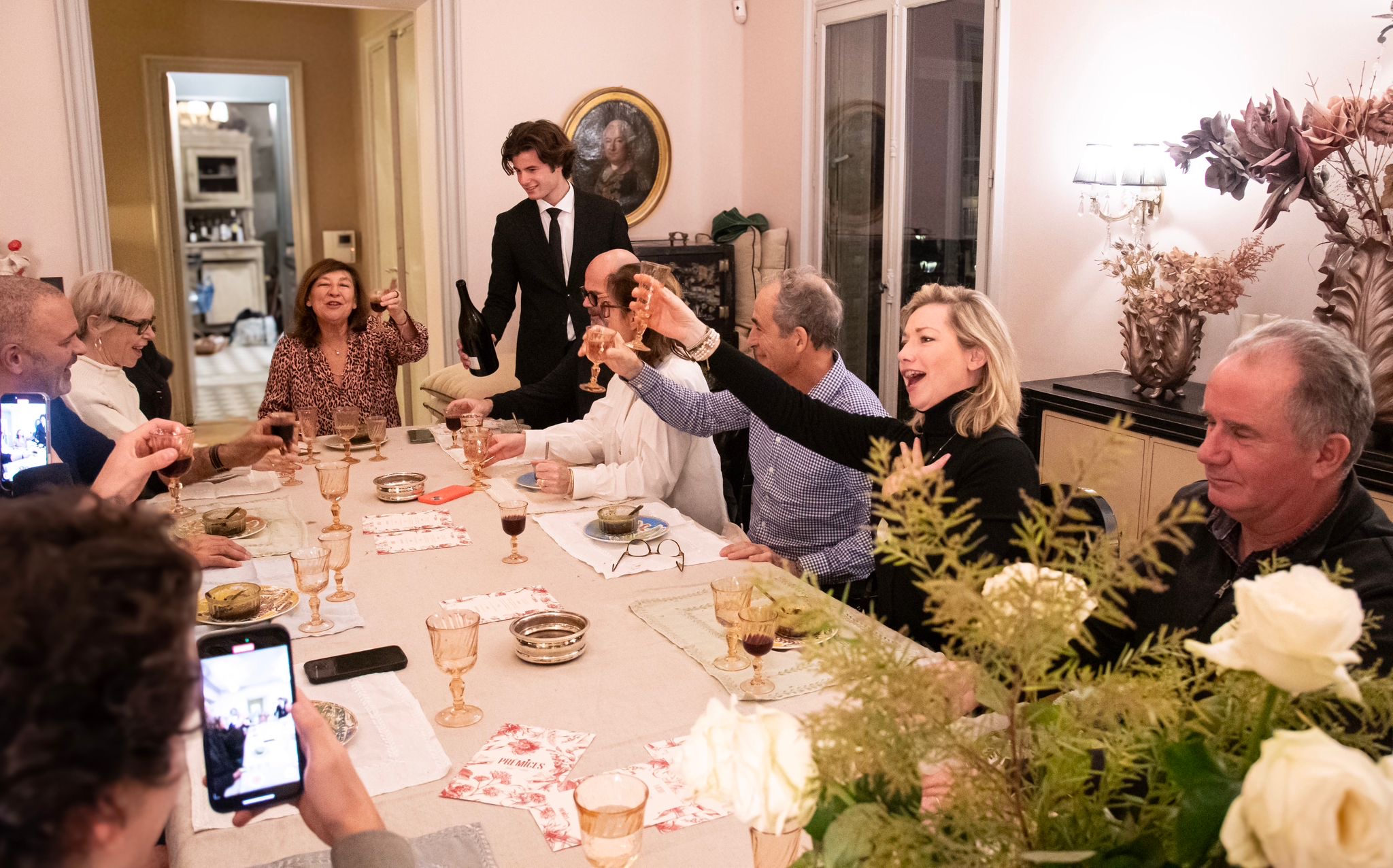
This article goes through these pairings case by case. For the general principles, see our food and wine pairing guide or our complete pairing chart. To have the wines chosen for your next dinner or event, our sommeliers, some of them Meilleurs Ouvriers de France, build the selection around your menu: discover our sommellerie.
Why does red meat call for a structured red?
The tannins in red wine react with the proteins and fat of the meat, producing a sensation of roundness. The fat released by cooking gives the tannins something to bind to, so they soften and integrate rather than feel harsh. That is why a very tannic wine can taste rough with lean poultry yet perfect with a marbled rib-eye. The principle holds for grilled meat; it becomes more complex as soon as the cooking changes, a sauce comes in or the meat is served raw.
Grilled or rare beef
Rare grilled beef is where young, firm tannins show best: the heat releases the intramuscular fat that softens the wine's structure. The more marbled the cut, the more powerful the wine can be.
Rib-eye, côte de boeuf and sirloin
For a rare rib-eye or a characterful côte de boeuf cooked over wood, choose a red with firm tannins and ripe black fruit: Pauillac or Saint-Émilion are the classics. Pauillac's dominant Cabernet Sauvignon stands up to intense marbling, while Saint-Émilion's Merlot offers a silkier roundness for a finer cut. A Côte-Rôtie, with its peppery Syrah, is an excellent alternative on a flame-grilled côte de boeuf. Sirloin, less marbled, calls for a slightly less massive wine: a Saint-Émilion Grand Cru or a Pomerol will be more balanced than a young Pauillac.
Bavette with shallots and onglet
Bavette with shallot sauce calls for a suppler red with fresh red fruit: a village Burgundy (Savigny-lès-Beaune, Chorey-lès-Beaune) or a Chinon works better than a powerful Bordeaux. The long fibre of bavette is finer than rib-eye, and the shallot sauce, with its acidity and slight caramelisation, wants acidity rather than tannic power. Onglet follows the same logic, more tender and more beefy: a well-chosen village Burgundy or a Saumur-Champigny are elegant matches.
Steak tartare: the case of raw meat
Tartare is the one red meat that dislikes a powerful Bordeaux. Without cooking, no fat has been released and there is no Maillard reaction, so strong tannins feel harsh and metallic on the raw protein. A village Burgundy or a supple Pinot Noir (Givry, Rully) is the most consensual pairing. For the adventurous, a white Hermitage or a Condrieu, ample northern Rhône whites with floral aromas, make a bold, surprising and memorable match.
Slow-cooked and braised meats
Long cooking breaks down the fibres and dissolves collagen into gelatine, creating a melting texture and flavours more complex than the meat alone. The wine used in the recipe is often the best starting point for the wine at the table.
Boeuf bourguignon and daube provençale
With boeuf bourguignon, serve the same grape used in the pot: a Burgundy Pinot Noir lifts the dish where a tannic Bordeaux would crush it. Nuits-Saint-Georges for depth and structure, Gevrey-Chambertin for more aromatic complexity, Mercurey for a more accessible choice in the same spirit. Avoid Burgundies that are too young, whose tannins lack the roundness the dish needs. A daube provençale, with its black olives, thyme and candied orange, calls for a wine from the same terroir: a red Bandol, whose tannins are wrapped in garrigue spice, or a Gigondas with the same southern signature.
Pot-au-feu
Pot-au-feu is the lightest red meat on the palate and calls for a fruity, low-tannin red, or the wine will mask the vegetables in the broth. A Beaujolais-Villages, a Brouilly or a light Bourgueil are the best matches; a deliberate surprise, a white Beaujolais, answers the vegetables and broth with remarkable coherence.
Lamb
Lamb calls for elegant reds with silky rather than massive tannins: Burgundy (Pommard, Gevrey-Chambertin) and Bandol are the two references. For a herb-roasted leg, a Pommard Premier Cru is the classic, its silky tannins and red fruit embracing the meat; Gevrey-Chambertin is spicier and more complex; a red Bandol brings restrained power and garrigue notes that echo rosemary and thyme. For a pink rack of lamb, finer than the leg, an elegant Burgundy Pinot Noir or a Côte-Rôtie (the appellation allows up to 20% Viognier alongside Syrah) brings a floral note that works beautifully. A slow-cooked shoulder moves towards the braised register: a Faugères or Saint-Chinian from Languedoc, rustic and spicy, completes its richness.
Game
Game tolerates the oldest and densest wines: the softened tannins of a bottle aged eight to twelve years embrace the wild notes of the meat. Furred game (roe deer, wild boar, venison) has firm, lean flesh with intense, sometimes animal notes and needs dense, powerful wines: Madiran, the historic South-West match, a mature Châteauneuf-du-Pape, an evolved red Bandol or a structured Cahors, preferably with some years in the cellar. Feathered game (pheasant, partridge, woodcock) is finer, often served as a salmis: northern Rhône Syrah (Côte-Rôtie, Hermitage), with its pepper, violet and smoked notes, is the reference, and an old Gevrey-Chambertin with earthy, forest-floor notes is a superb match.
Does the sauce choose the wine more than the meat?
For plain grilled meat, the meat dictates the pairing. As soon as a rich sauce comes in, the sauce becomes the main parameter.
- Béarnaise (butter, tarragon, acidity): its buttery richness and green note lighten the pairing, allowing a fine Burgundy rather than a powerful Bordeaux on a rib-eye; the tarragon's acidity calls for freshness.
- Pepper and cognac sauce: very aromatic, with black fruit and spice, it calls for a spicy Rhône red (Châteauneuf-du-Pape, Crozes-Hermitage) or a Madiran with the density to hold their own.
- Bordelaise (red wine reduction, marrow, shallot): the most direct logic, serve a red close to the one used in the sauce.
- Mushroom sauce: umami and earthy notes call for an evolved Pinot Noir whose forest-floor aromas echo the mushrooms; a Burgundy with a few years of age is ideal.
Can white wine really go with red meat?
In two precise cases. With tartare, a white Hermitage or a Condrieu is bold but coherent: the ample texture and absence of tannins suit raw protein. With light summer grills (barbecued lamb chops, marinated beef skewers, grilled bavette), a structured Provence rosé or a Tavel, dense and vinous, is a complete and perfectly valid match. What does not work: a Chablis or Sancerre with a rib-eye, where lively acidity and the absence of tannins produce a flat, sometimes metallic pairing.
A red meat centrepiece for your next dinner? Our sommeliers choose the wines with your chef. Request a quote.
Frequently asked questions
Which red wine with a côte de boeuf?
For a large côte de boeuf, rare and flame-grilled, Pauillac is the reference: dominant Cabernet Sauvignon, firm tannins and ripe cassis stand up to the fat. A Saint-Émilion Grand Cru is a suppler, rounder alternative; outside Bordeaux, a mature Côte-Rôtie brings a remarkable spicy, floral dimension to beef cooked over embers.
Which wine with boeuf bourguignon?
A Burgundy Pinot Noir as a regional pairing: Nuits-Saint-Georges for structure and depth, Mercurey for a slightly more accessible choice. Avoid a young, tannic Bordeaux. The simple rule: the same grape in the sauce and in the glass, with three to five years of age for well-integrated tannins.
Can you serve Bordeaux with lamb?
Yes, but Burgundy usually answers better. A Saint-Émilion Merlot with roast leg of lamb is satisfying, but a Pommard or Gevrey-Chambertin offers an elegance and silkiness that Bordeaux's often more massive structure lacks against the natural sweetness of lamb. For a delicate pink rack, Bordeaux is clearly less suited.
Which wine with roe deer or wild boar?
Wines with real density and a few years of age: Madiran, a mature Châteauneuf-du-Pape or an evolved red Bandol. The firm, lean, wild flesh needs softened rather than young, astringent tannins. A ten-year-old great Bordeaux (Saint-Estèphe, an evolved Pauillac) also works well with a saddle of venison and reduced jus.
Should the wine be opened ahead for red meat?
For young tannic reds (Bordeaux under eight years, Madiran, Cahors, young Bandol), decant for 30 to 60 minutes: aeration softens the tannins and releases the aromas. For evolved Burgundies and wines over twelve years, keep it to 10 to 15 minutes to avoid oxidation; mature, fragile wines can be served straight from the bottle after standing upright to settle.