
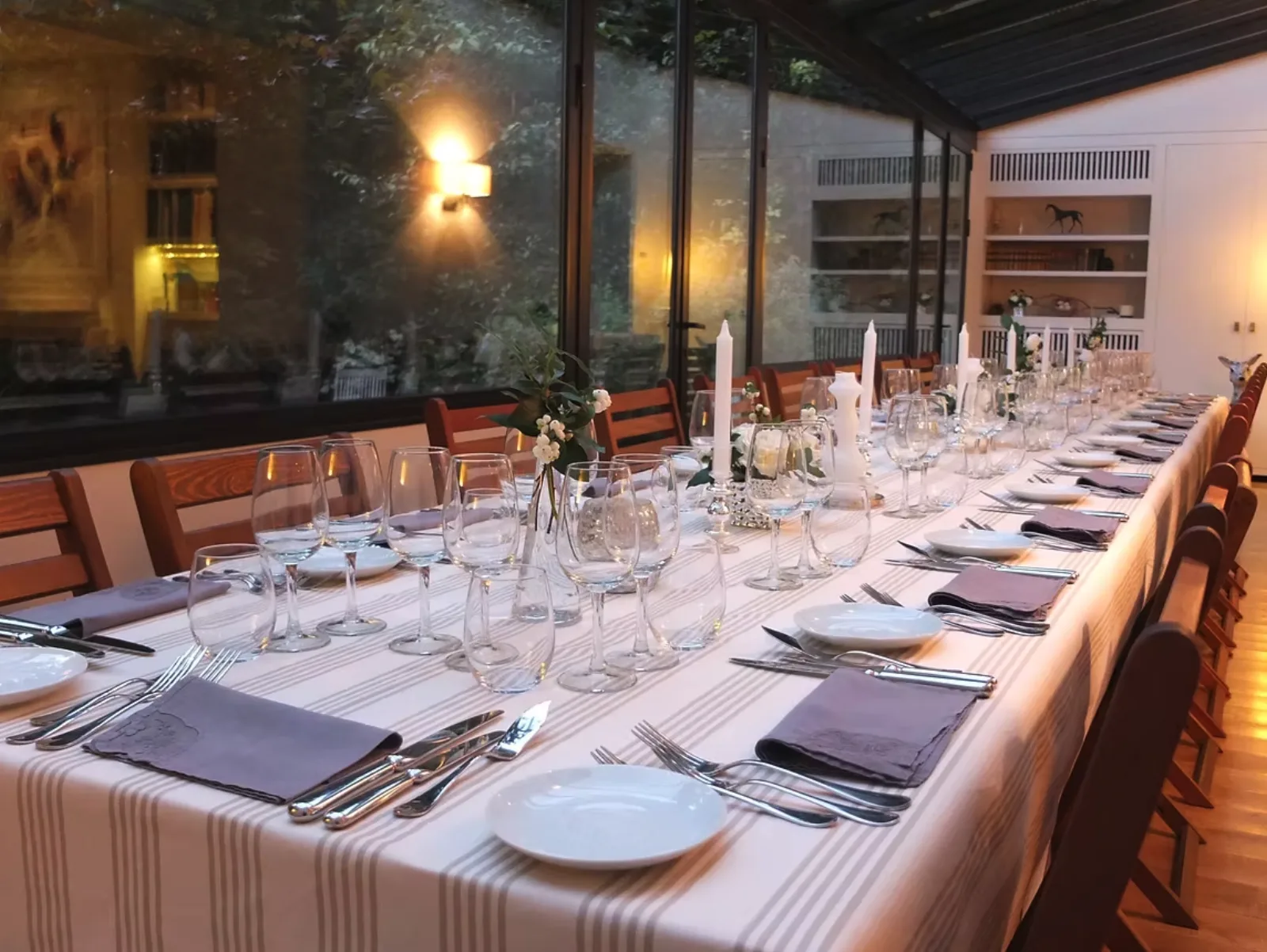
Defining the format of your reception
The first decision is often the most structuring: which format suits the occasion, the number of guests and the atmosphere you want? The format determines the space needed, the level of service, the menu and ultimately the budget. Three formats dominate private receptions.
Seated dinner, cocktail dinner or buffet
| Format | Atmosphere | Suitable guest numbers | Level of service | Strength |
|---|---|---|---|---|
| Seated dinner | Intimacy, focused conviviality | 10 to 80 people | High (1 waiter per 8 to 10 guests at the high end) | Structured courses, a complete gastronomic experience |
| Cocktail dinner | Free movement, conversation | 30 to 300 people | Moderate (1 waiter per 30 to 40 guests) | Flexible, ideal for mixing groups and large spaces |
| Buffet | Self-service, broad conviviality | 30 people and more | Reduced | Saves on service, for large family or business receptions |
For a gastronomic dinner at home, the seated format is the natural choice: it showcases each course, builds a progression of flavours and gives the chef room to express their talent. The cocktail dinner favours conversation and flow, with 15 to 20 pieces served while guests circulate.
The mixed reception: a welcome cocktail followed by a seated dinner
The mixed format is the hallmark of high-end receptions. Guests are welcomed with a 45-minute to one-hour cocktail, with amuse-bouches and drinks, so everyone can arrive at their own pace; moving to the table then marks the shift to the intimacy of dinner. It combines the social ease of a cocktail with the gastronomic depth of a dinner. Logistically, it requires two separate spaces or a room turnaround, and precise coordination between the maître d' and the kitchen. It is more demanding, but it is also what creates the effect from the moment guests arrive.
Calibrating guest numbers and space
One of the most common mistakes is underestimating the space needed. Professional ratios are precise and little known to private hosts.
Space ratios
For a seated meal, allow 1.5 to 2 m² per person, including table, chairs and circulation. For a standing cocktail, 0.5 to 1 m² per person. If you plan a dance floor, add about 0.5 m² per dancing guest. For example, 60 guests at a seated dinner with a working service area need at least 130 m² of usable space. Below that, service becomes uncomfortable and the experience suffers.
How many waiters for a high-end reception?
Staffing ratios are a direct marker of quality. Standard table service is one waiter per 25 covers; high-end service drops to one waiter per 8 to 10 guests, which guarantees attentive presence and well-paced courses. For a cocktail dinner, one waiter per 30 to 40 guests is enough, since service happens on the move. A maître d' becomes essential from about 30 guests to coordinate the whole, handle the unexpected and keep kitchen and room in sync.
Choosing the venue
At home: advantages and practical constraints
Hosting at home offers total freedom of decoration, no hire fees and a personal setting full of meaning for your guests. For an intimate birthday or a dinner with close friends, it is often the most coherent choice. A private chef does, however, need an equipped kitchen and enough room to prepare and plate, and service needs clear circulation. From around 30 guests for a seated dinner, or 60 to 80 for a cocktail, a home usually reaches its practical limits.
Exceptional venues: châteaux, villas, rooftops, estates
When the occasion calls for an exceptional setting, hiring a venue transforms the experience. These spaces have professional kitchens, cloakrooms, parking and sometimes their own house staff. Indicative hire costs in France range from 100 to 600 euros for a municipal hall, 1,000 to 4,000 euros for a private reception room, and 1,000 to 15,000 euros for an estate or château depending on capacity and season. Prémices gives access to a selection of partner venues suited to each type of reception, with precise knowledge of each space.
Designing the menu
The menu is what your guests will remember. Logistics stay backstage; the food is what stays in memory.
A seasonal menu, local produce
A private chef works with the seasons for flavour first and value second: asparagus in spring, mushrooms in autumn, citrus in winter. A classic reception menu includes amuse-bouches on arrival, a starter, a main course, possibly a cheese course, and dessert; for larger tables, a pre-dessert or an amuse-bouche between courses refines the experience. The chef systematically adapts the menu to dietary needs (vegetarian, major allergens, gluten intolerance), which must be gathered beforehand.
Food and wine pairing: the detail that elevates a reception
Pairing is one of the strongest differentiators of a high-end reception, and one of the least used by private hosts. A sommelier does not just choose the bottles: they build a progression that supports the menu, subtly educates the guests and creates moments of surprise. Options range from one wine per course to a commented wine bar or a full tasting led by an expert. The Prémices wine pairing option calls on selected sommeliers, some of them Meilleurs Ouvriers de France.
Orchestrating the service
Service is the backbone of a reception; it is only noticed when it fails. Perfect service is the one nobody mentions because everything flowed naturally.
The role of the maître d'
The maître d' is the invisible conductor of the evening. They link kitchen and room, signal the move to the table, pace the courses to avoid both lulls and rushing, and handle the unexpected without guests noticing. From around twenty guests at a served dinner, their presence fundamentally changes the experience. Selected waiters know the codes of the table, anticipate needs without being asked and remain discreet yet attentive all evening.
Timing of a successful reception
Arrivals naturally spread over 30 to 45 minutes; the welcome cocktail absorbs this. The move to the table happens on a discreet signal from the maître d'. Between courses, 15 to 20 minutes is ideal: long enough to savour and talk, short enough to keep the momentum. Coffee and petits fours close the evening in a relaxed way, as guests move around and conversations reshuffle.
The budget of a private reception
Surprises rarely come from the main item but from the satellite costs nobody anticipated.
| Item | Estimated share of budget | Indicative market range |
|---|---|---|
| Caterer or chef | 40 to 50% | 25 to 120 euros per person depending on the formula |
| Venue hire | Variable | 100 to 15,000 euros depending on the venue |
| Drinks | 10 to 15% | Depends on the wines and the length of the event |
| Service (waiters, maître d') | 10 to 20% | Depends on the format and ratios |
| Decoration | 5 to 15% | Depends on the investment |
| Entertainment, music | 5 to 10% | Depends on the type of act |
The caterer or chef always accounts for 40 to 50% of the total: it is the central item around which the other choices are made. These ranges are market benchmarks that vary with format, guest numbers and level of service; Prémices prices are quoted per project.
Why use a gastronomic agency
Organising a reception for 50 people alone means dozens of hours of coordination: finding an available chef, a suitable venue, waiting staff, wine pairings, then coordinating everyone on the day. An agency gives you a single point of contact for chef, venue, service, sommellerie and on-the-day coordination, and guarantees that every element fits together. The host can be fully present for their guests.
Formalities in France: what to know
A private party at home: no authorisation required
For a strictly private party in a private place with fewer than 250 guests, no declaration to the town hall is needed. The condition is that it remains genuinely private: named invitations, no ticket sales, a closed event. Above 250 people, the rules for establishments open to the public may apply depending on the venue; hired venues generally hold the necessary authorisations.
Noise and neighbours
Night-time noise disturbance is prohibited between 10pm and 7am in France, with a fixed fine of 68 euros if paid within 45 days, 180 euros after that, and up to 450 euros. The simplest prevention is to warn your neighbours in advance. Some towns have specific bylaws on noise, so check local rules, especially for outdoor receptions.
SACEM: is a declaration needed?
For a free private party within a strictly family or friendly circle, no declaration to SACEM (the French music rights society) is required. As soon as the event has revenue (tickets, a paying bar) or opens to people outside the private circle, a declaration becomes mandatory.
Entrusting your reception to a gastronomic agency
When to call on a professional
Three situations justify delegating: volume, since from about twenty guests the coordination between chef, service and venue exceeds what a non-professional host can manage without stress; stakes, for an anniversary dinner or an event for business relations that calls for excellence; and the simple wish to enjoy your guests instead of managing the kitchen, timing and the unexpected.
What Prémices orchestrates from start to finish
Prémices is a gastronomic agency whose core business is the complete orchestration of bespoke private receptions. Chefs are selected on strict criteria: tasting tests, punctuality, quality of plating, hygiene standards, reflected in a 4.9/5 rating on Google. Beyond the chef, Prémices connects you with its partner venues, coordinates waiters and maîtres d', and offers the sommellerie option. Our bespoke events service covers every step, from menu design to coordination on the night. The host is a guest like any other.
A private reception to plan? Request a quote and we will reply within 24 hours.
Frequently asked questions
How many guests for a successful private reception?
A seated dinner works best for 10 to 50 guests, favouring intimacy and the full gastronomic experience. A cocktail dinner suits much larger groups, up to 200 people and beyond. At home, the practical limit is around 30 to 40 guests for a seated dinner and 60 to 80 for a cocktail, depending on the space.
Do I need permission to host a private reception at home?
No. For a strictly private party in a private place with fewer than 250 guests, no declaration to the town hall is required in France. The only regulatory constraint concerns neighbours: night-time noise is prohibited between 10pm and 7am.
What is the difference between a private reception, a cocktail dinner and a gastronomic dinner?
A private reception is the overall setting: an event in a private space, at home or in a hired venue. The cocktail dinner and the seated dinner are two service formats within it: the first relies on movement and conversation, the second on a gastronomic progression and the intimacy of the table.
How much does a private reception cost on average?
The caterer or chef accounts for 40 to 50% of the total budget, with market ranges of 25 to 120 euros per person depending on the level of service. The venue varies from 100 euros for a municipal hall to 15,000 euros for an estate or château. For a premium reception with a private chef, selected staff and a sommelier, Prémices quotes per project.
Do I need to declare my private party to SACEM?
Not for a free private party within a strictly family or friendly circle. A declaration becomes mandatory when the event has revenue (tickets, a paying bar) or opens to a wider public.